Buying guide
Best Self-Emptying Robot Vacuums in 2026: 10 Picks Ranked Honestly
By Rosa Pemberton · Reviews editor
Last updated
We earn commissions from links on this page, at no cost to you. Our picks stay independent. Prices are indicative and were last checked around publication — they change often, so confirm the current price on the retailer’s site. How we research & rank →
Our picks
Ranked, with the trade-offs

Roborock Budget Sonic Mop
from
$299
Affordable LiDAR vacuum-mop with sonic vibration mopping and 70-day self-empty dock.
Pros
- + Excellent price-to-value ratio with full vacuum-mop combo and self-emptying
- + Strong carpet and hard-floor pickup despite lower suction class
- + Dual anti-tangle brush system significantly reduces hair clogging
Cons
- – Weak obstacle avoidance (6/24 in testing)
- – Basic structured-light sensors only, no camera-based detection

Shark AI Ultra 30-Day
from
$448
Budget-friendly self-emptying robot with powerful suction and LiDAR mapping; ideal for pet owners on a tight budget.
Pros
- + Exceptional value at ~$250; typically sold at 50% discount from $550 MSRP
- + Self-cleaning brushroll prevents hair tangling, especially for pet homes
- + Matrix Clean grid navigation ensures thorough multi-pass coverage with no missed spots
Cons
- – 30-day bag capacity is shorter than competitors; requires more frequent replacements
- – No mopping or hot-water washing features; vacuum-only functionality

Tapo RV30 Max Plus
from
$229.99
Ultra-affordable 2-in-1 vacuum-and-mop combo with LiDAR mapping and 60-day dust bag; best value for budget buyers.
Pros
- + Lowest total cost-of-entry under $230; strong value proposition with modest feature set
- + 60-day dust bag holds more debris than Shark's 30-day equivalent
- + LiDAR navigation avoids most obstacles and creates accurate home maps
Cons
- – Lower suction (5,300 Pa) struggles with deep carpet embedding compared to 10K+ models
- – Mopping performance is basic; no hot-water washing or drying in dock

Yeedi M14 Plus Plus
from
$499.99
Best-value flagship killer with roller mop that rinses mid-clean and AI obstacle avoidance; rated #1 budget pick by Vacuum Wars.
Pros
- + OZMO Roller system continuously rinses with fresh water during cleaning—not just at dock return—beating traditional pads that smear dirt
- + 18,000 Pa suction and 167°F hot-water mop washing rivals models costing $300+ more
- + AIVI 3D 3.0 with AI obstacle avoidance scored 16/24 in Vacuum Wars torture tests—best in budget tier
Cons
- – Dock integration is more compact but fewer extra automation features (no auto-refill, no detergent dispenser)
- – Some users report mop rinsing cycle can be lengthy, extending total dock time

eufy Omni C28 HydroJet
from
$499.99
Premium-tier mopping champion with aggressive HydroJet roller and full 5-in-1 dock at mid-range price; best for sticky messes.
Pros
- + HydroJet roller mop with 270 RPM and 24 water ports outperforms dual-pad systems on dried stains (coffee, ketchup, mustard)
- + 5-in-1 omni station includes rare features: auto-detergent dispensing, continuous hot-air drying, and self-cleaning cycle
- + 15,000 Pa suction combined with roller mop design creates outstanding floor scrubbing action
Cons
- – Largest dock footprint among peers—requires significant corner/hallway space for placement
- – HydroJet roller-mop design messier to maintain than newer bagless docks; requires manual water tank swaps

ECOVACS DEEBOT X2 Omni
from
$699.99
Square robot with strongest-in-category automation: 15mm mop lift, 90-day bag, hot water wash, and AI pet detection.
Pros
- + 15mm mop auto-lift is highest in industry for near-universal carpet compatibility without manual pad removal
- + Square body design reaches corners and edges 10-15% better than round competitors
- + 90-day dust bag and auto water-refill reduce manual intervention; quietest tested at 53 dB on low mode
Cons
- – 8,000 Pa suction trails behind Roborock/Shark at 10K+ Pa; struggles on deep-pile carpets vs. mid-tier rivals
- – Complex 5-in-1 omni dock requires more setup space and occasional manual water-tank maintenance
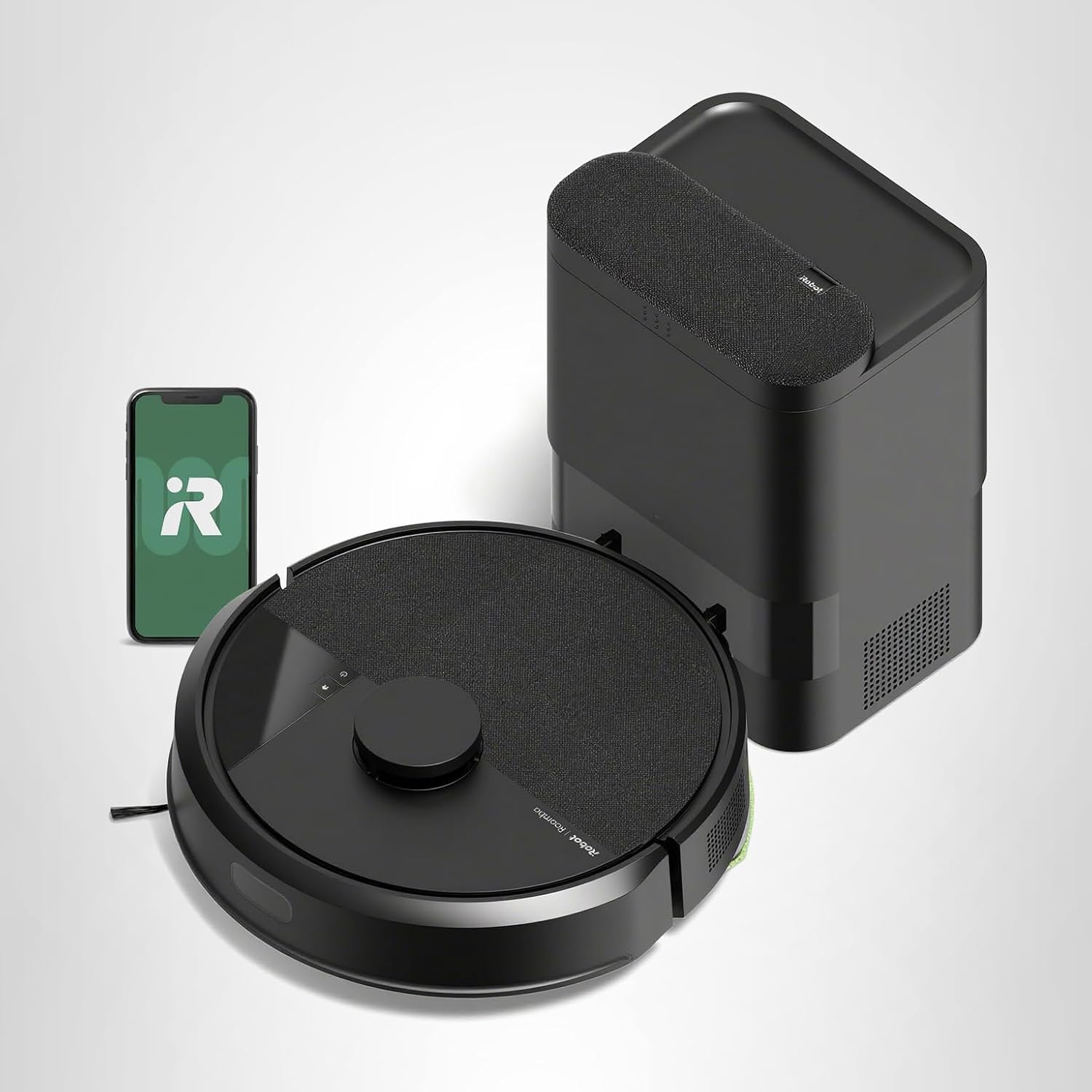
iRobot Roomba 105 Vac
from
$399.99
Entry-level Roomba with iRobot ecosystem integration and 75-day auto-empty; best for Alexa/Google Home users.
Pros
- + iRobot ecosystem integration with Alexa/Google Home; works with existing Roomba app and voice routines
- + 75-day dust bag capacity competitive with mid-range models at budget price point
- + 3-Stage Cleaning System with edge-sweeping brush designed for corners and wall transitions
Cons
- – Suction not specified in absolute Pa units; 70X claim vs. old 600 series is not directly comparable to competitors
- – Vacuum-only by default; mopping requires manual pad purchase and water tank fill—less integrated than true 2-in-1 rivals

Dreame L50 Ultra Plus
from
$799.99
High-end value pick with industry-leading 100-day dust bag, ProLeap leg climbing, and exceptional carpet deep-clean.
Pros
- + 100-day dust bag is longest-interval in entire market; reduces replacements to 3-4x yearly
- + ProLeap retractable legs (6cm climb) enable access under furniture unreachable by standard designs
- + Vacuum Wars tested 90% carpet deep clean—top-5 all-time score; proven 3-month real-world reliability
Cons
- – Flagship L60 and X-series now leapfrog performance; L50 gradually losing top-tier position
- – Large omni dock footprint and leg mechanism add complexity vs. traditional round designs
iRobot Roomba 105 Combo
from
$649.99
True 2-in-1 Roomba with integrated mopping, auto carpet avoidance, and 75-day self-empty; best for Alexa users wanting combo.
Pros
- + Auto-detects and retracts mop pads on carpets—rare at this price tier; no manual mode switching
- + Integrated water tank and mop pad in robot body simplifies setup vs. separate dock water systems
- + Alexa voice control with customizable cleaning passes and suction levels
Cons
- – Mopping relies on single microfiber pad (no dock washing/drying); pad must be hand-washed after use
- – No mopping automation (hot water, drying, dispensing); limited to manual refill and pad maintenance

Shark AI Ultra 60-Day XL
from
$399.99
Mid-tier Shark with 60-day XL dust bag and matrix navigation; doubles self-empty interval of 30-day model.
Pros
- + 60-day XL dust bag doubles cleaning intervals vs. standard 30-day models; fewer replacements annually
- + Self-cleaning brushroll prevents pet hair tangles; Matrix Clean grid multi-pass ensures thorough coverage
- + HEPA filtration traps 99.97% dust/allergens down to 0.3 microns—best for allergic households
Cons
- – Vacuum-only; no mopping capability or mop washing features at any price point
- – XL base is larger footprint than compact Tapo/iLife alternatives; requires more dock space
The verdict
Our top picks at a glance
Budget-conscious buyers wanting auto-empty convenience and solid suction without premium features.
Pet owners and budget-conscious buyers seeking powerful suction at entry-level pricing.
Budget-conscious buyers who want basic vacuuming and mopping without premium features.
Budget-conscious buyers who want flagship-level automation and deep carpet cleaning without premium pr…
At a glance
How they compare
| Spec | Top pickRoborock Budget Sonic Mop | Shark AI Ultra 30-Day | Tapo RV30 Max Plus |
|---|---|---|---|
| Price | $299 | $448 | $229.99 |
| Battery | 5,200 mAh (150 min) | 120 min runtime | Multi-floor mapping |
| Mopping | VibraRise 2.0 (3,000 vib/min) | Not included | — |
| Navigation | LiDAR + ReactiveTech sensors | 360° LiDAR | LiDAR + IMU |
| Suction Power | — | 12,000 Pa | 5,300 Pa |
| Check price → | Check price → | Check price → |
Top 3 of 10 shown — full shortlist above.
Self-emptying robot vacuums have crossed a tipping point. LiDAR navigation, 60-plus-day dust bags, and full-service docks with hot-water mop washing — features that cost $1,500 or more just a few years ago — are now available in the $300–$800 range. That’s genuinely good news for buyers, but it also makes the category harder to parse.
After researching every major model available in 2026 against consistent criteria (suction, dock features, navigation, hair handling, and real ownership data), my top overall pick is the Roborock Q10 S5+. It hits the best balance of strong suction, effective mopping, and low-maintenance dock features in the mid-range sweet spot. If budget is the main concern, the Yeedi M14 Plus is the most capable vacuum under $500.
Here are the ten best self-emptying robot vacuums ranked, with honest takes on who each one is and isn’t for.
What is the best self-emptying robot vacuum right now?
The Roborock Q10 S5+ is the best self-emptying robot vacuum for most people in 2026. It delivers 10,000 Pa HyperForce suction, VibraRise 2.0 sonic mopping that genuinely handles dried stains, a 70-day dust bag (the longest in its price tier), and a Dual Anti-Tangle system that scored 0% hair entanglement in Vacuum Wars testing. For a home that needs both vacuuming and mopping without spending flagship money, nothing else at this price range matches it on all fronts.
Roborock Q10 S5+ — best overall
Best for: Buyers wanting the best value combination of suction, mopping, and low dock maintenance in the mid-range.
Specs: 10,000 Pa HyperForce suction | VibraRise 2.0 sonic mopping | Dual Anti-Tangle (JawScrapers + anti-tangle side brush) | 70-day dust bag | LiDAR mapping
The Q10 S5+ earns the top spot because it does more things well without forcing trade-offs. The VibraRise 2.0 system uses sonic scrubbing rather than simple pad dragging, which makes a real difference on dried kitchen spills — coffee rings, ketchup spots — where passive mopping just pushes residue around. Vacuum Wars testing recorded 0% hair entanglement across 7-inch hair tests, which puts it in a very small category of genuinely tangle-free designs. The 70-day bag is the longest interval in this tier, meaning you’re touching the dock maybe five times a year.
The dock doesn’t wash or dry the mop pads with hot water, which is the main compromise at this price point. The sonic mopping vibration is also slightly louder than rotating-pad alternatives. But if you’re not running it in the middle of the night, it’s a reasonable trade.
Pros:
- 70-day dust bag is the longest interval in mid-tier
- Sonic mopping outperforms passive dual-pad systems on dried stains
- 0% hair entanglement in Vacuum Wars testing
Cons:
- No hot-water mop washing or hot-air drying at the dock
- Sonic vibration is slightly noisier than pad-rotation alternatives
Price tier: Mid-range
Yeedi M14 Plus — best budget flagship
Best for: Buyers wanting hot-water mop washing and AI obstacle avoidance under $500.
Specs: 18,000 Pa suction | OZMO Roller 2.0 (200 RPM, fresh-water rinsing mid-clean) | 167°F hot-water mop washing | AIVI 3D 3.0 obstacle avoidance | 60-day dust bag
Vacuum Wars rated the M14 Plus their #1 budget pick, and the reasoning is clear. The OZMO Roller 2.0 doesn’t just park at the dock and get washed — it rinses with fresh water continuously during the cleaning run. That means you’re not dragging a progressively dirtier pad across your floors the way most mopping robots do. At 18,000 Pa, suction rivals models costing significantly more. The AIVI 3D 3.0 obstacle avoidance system scored 16/24 in Vacuum Wars torture tests, the best result in the budget tier.
The dock is more compact than competitors, which is a plus for smaller homes, but it doesn’t include auto water-refill or detergent dispensing. Some owners report the mop-rinsing cycle extends total dock time noticeably. Those are real limitations, but at this price, they’re easier to accept.
Pros:
- Fresh-water roller rinse during cleaning, not just at dock return
- 18,000 Pa suction and 167°F hot-water washing at budget pricing
- Best obstacle avoidance score in its price tier
Cons:
- No auto water-refill or detergent dispenser in dock
- Lengthy mop-rinsing cycles extend dock dwell time
Price tier: Budget (under $500)
eufy Omni C28 — best for sticky messes and kitchen floors
Best for: Kitchen-heavy homes and pet owners who need serious mopping automation.
Specs: 15,000 Pa suction | HydroJet self-cleaning roller mop (270 RPM, 24 water ports) | 5-in-1 Omni Station (auto-empty, mop wash, hot-air dry, detergent dispense, self-clean) | AI obstacle avoidance | 75-day dust bag
The HydroJet roller at 270 RPM with 24 water ports is a genuinely aggressive mopping system, and the 5-in-1 dock is one of the most complete in the market at this price. Auto-detergent dispensing and continuous hot-air drying are rare even among premium models — having both under $500 is notable. Consumer Reports rates Eufy models near the top for reliability, which matters in a device you’re trusting to run unsupervised.
The dock is large and needs meaningful floor space. The roller-mop design also requires more manual maintenance than some newer dock formats — water tank swaps are manual, and the roller itself needs occasional attention. If dock footprint is a concern in a smaller home, that’s worth weighing.
Pros:
- HydroJet 270 RPM roller outperforms dual-pad systems on dried stains
- 5-in-1 dock includes detergent dispensing and hot-air drying (rare at this tier)
- Strong reliability ratings from Consumer Reports
Cons:
- Large dock footprint requires dedicated corner or hallway space
- Manual water tank swaps; roller mop requires more upkeep than some alternatives
Price tier: Mid-range
ECOVACS DEEBOT X2 Omni — best for corners and full dock automation
Best for: Tech-forward buyers and pet owners who want maximum dock automation and genuinely better corner coverage.
Specs: Square body design | 8,000 Pa suction | OZMO Turbo 2.0 with 15mm auto-lift | 140°F hot-water mop washing | auto-empty, hot-air drying, auto water-refill | 90-day dust bag | 53 dB on low mode
The square body is functional, not just a design choice — it gets into corners and along edges 10–15% better than round robots, which matters in rooms with lots of furniture legs and tight angles. The 15mm mop auto-lift is the highest in the industry, meaning it handles most carpets without you ever pulling the pads off manually. The 90-day dust bag and auto water-refill push manual intervention to a bare minimum, and at 53 dB on low mode it’s notably quiet for overnight runs.
The 8,000 Pa suction is the biggest trade-off. It trails the Roborock Q10 S5+ and several budget competitors on deep-pile carpet extraction. If your home is mostly hard floors with area rugs, it’s fine. If you have thick carpet throughout, look elsewhere.
Pros:
- Square body improves corner cleaning by 10–15% vs. round designs
- 15mm mop auto-lift is highest in the category
- 90-day bag + auto water-refill means minimal weekly interaction
Cons:
- 8,000 Pa suction is the lowest among top-tier picks; struggles on deep-pile carpet
- Complex dock requires setup space and occasional manual water-tank maintenance
Price tier: Upper mid-range
Dreame L50 Ultra — best for large, complex homes
Best for: Buyers with multi-level homes, low furniture, and heavy carpet who want near-premium performance at a step below flagship pricing.
Specs: 19,500 Pa Vormax suction | ProLeap retractable legs (6cm obstacle climbing) | 167°F hot-water mop washing (4 temp settings) | RGB + 3D structured light AI obstacle avoidance | 100-day dust bag
The 100-day dust bag is the longest interval in the entire robot vacuum market — you’re emptying three or four times a year. ProLeap retractable legs let the robot climb 6cm obstacles, enabling access under furniture that defeats standard designs. Vacuum Wars tested it at a 90% carpet deep-clean score, placing it in their all-time top five. For a home with thick rugs, low couches, and a lot of square footage, that combination is hard to beat.
The L50 is gradually being leapfrogged by Dreame’s own newer flagship models (the L60 and X-series), so it’s not the cutting edge anymore. The large dock and leg mechanism also add complexity. It’s still an outstanding performer, but buyers who want the absolute latest should know the positioning has shifted slightly.
Pros:
- 100-day dust bag, the longest interval in the market
- ProLeap legs climb 6cm — reaches under furniture most robots can’t
- 90% carpet deep-clean score in Vacuum Wars testing
Cons:
- Newer Dreame flagships now exceed its performance ceiling
- Large dock footprint and leg mechanism add mechanical complexity
Price tier: Premium
Shark AI Ultra (AV2501S) — best budget vacuum-only pick
Best for: Pet owners on a tight budget who need strong suction and no-fuss hair handling.
Specs: 12,000 Pa suction | 360° LiDAR | Matrix Clean grid navigation | Self-cleaning brushroll | 30-day dust bag
At roughly $250 (frequently discounted from a much higher MSRP), this is the entry point for serious self-emptying performance. The self-cleaning brushroll is a genuine differentiator at this price — most budget robots accumulate pet hair wraps that require manual cutting every few weeks. Matrix Clean grid navigation ensures multi-pass coverage without the random bounce pattern that leaves strips of carpet untouched.
The 30-day bag capacity is the shortest here, which means more frequent dock maintenance than any competitor. There’s also no mopping functionality at any price point on the Shark AI Ultra lineup. If you want a vacuum-only machine that prioritizes suction and hair handling over convenience features, this is the pick. If you need mopping, look at the Tapo or Yeedi options.
Pros:
- Exceptional value; often available at roughly half of MSRP
- Self-cleaning brushroll handles pet hair without tangles
- Matrix Clean grid navigation covers high-traffic areas with multiple passes
Cons:
- 30-day bag capacity requires more frequent replacements than all competitors
- No mopping at any configuration
Price tier: Budget
Shark AI Ultra with XL 60-Day Base — best mid-tier vacuum-only
Best for: Pet owners and allergy sufferers who want the Shark brushroll system with less frequent bag changes.
Specs: 12,000 Pa suction | 360° LiDAR with Matrix Clean | Self-cleaning brushroll | HEPA filtration (99.97% at 0.3 microns) | 60-day XL dust bag
This is largely the same robot as the AV2501S with a larger dock that doubles the bag interval. The addition that matters most beyond the bag size is HEPA filtration — 99.97% particle capture down to 0.3 microns is the best allergen filtration in this roundup. For households with asthma or pet dander sensitivities, that’s worth the step up from the base model.
Like its cheaper sibling, it offers no mopping capability. The XL dock is also noticeably larger than compact alternatives. If mopping matters at all, this isn’t the machine.
Pros:
- 60-day XL bag doubles interval over the base model
- HEPA filtration is the strongest allergen capture in this roundup
- Self-cleaning brushroll continues to handle pet hair well
Cons:
- Still vacuum-only; no mopping at any price or configuration
- Larger dock footprint than compact alternatives
Price tier: Mid-range
TP-Link Tapo RV30 Max Plus — best ultra-budget combo
Best for: Renters and first-time robot vacuum buyers who want vacuuming and basic mopping under $230.
Specs: 5,300 Pa suction | LiDAR + IMU navigation | Vacuum & mop 2-in-1 | 60-day dust bag
This is the least expensive self-emptying robot with a mop function on this list, and for modest homes with hard floors and light foot traffic, it delivers. The 60-day bag is genuinely impressive at this price — it actually outlasts the Shark AV2501S that costs $20 more. LiDAR navigation produces accurate maps and avoids most obstacles without the random-path chaos of cheaper gyroscope-only robots.
The 5,300 Pa suction is the most significant limitation. It simply cannot extract embedded debris from medium or thick carpet the way 10,000 Pa machines can. Mopping is also passive and basic — there’s no dock washing, drying, or hot water. For an apartment with mostly hard floors and a rug or two, it’s fine. For anyone with wall-to-wall carpet or a dog, it will disappoint.
Pros:
- Lowest cost of entry in this roundup with mop functionality included
- 60-day dust bag outlasts models costing more
- LiDAR navigation for accurate mapping at budget pricing
Cons:
- 5,300 Pa suction struggles with carpet embedding vs. 10,000 Pa+ models
- Mopping is basic; no dock washing, drying, or hot-water features
Price tier: Budget
iRobot Roomba 105 Vac — best for iRobot ecosystem users
Best for: Buyers already using the iRobot app or with established Alexa/Google Home routines.
Specs: ClearView LiDAR | 3-Stage cleaning system (bristle brush + edge-sweeping) | 75-day dust bag | Optional mop pad attachment
The 105 Vac’s main selling point is ecosystem fit. If you already have Roomba routines set up in Alexa, an existing iRobot app configuration, or you just prefer the Roomba app’s room mapping interface, this maintains compatibility cleanly. The 75-day dust bag is competitive, and the edge-sweeping brush handles wall transitions better than most round robots.
The suction spec — “70X more power vs. Roomba 600 series” — doesn’t translate to a real comparison against modern competitors. iRobot doesn’t publish Pa figures, which makes direct comparisons impossible and forces you to rely on third-party testing. Mopping is add-on only, with no dock integration for washing or drying. Consumer Reports rates iRobot reliability as middling, which is worth noting at this price point.
Pros:
- Strong Alexa/Google Home integration for existing iRobot users
- 75-day bag competitive with mid-range models
- Edge-sweeping brush performs well along walls and corners
Cons:
- Suction not specified in Pa; comparison claim is not useful for cross-brand evaluation
- Mopping is an add-on, not integrated; no dock washing or drying
Price tier: Mid-range
iRobot Roomba 105 Combo — best integrated 2-in-1 Roomba
Best for: iRobot ecosystem users who want true 2-in-1 convenience without a complex dock.
Specs: ClearView LiDAR | Auto carpet avoidance | Microfiber mop pad (30-use reusability) | Cleaning modes: vacuum-only, mop-only, or combo | 75-day dust bag
The Combo model is a meaningful step up from the 105 Vac. The integrated water tank and auto carpet avoidance — the robot lifts the mop pad on carpets automatically — makes the 2-in-1 experience genuinely seamless rather than a compromise. You don’t need to remember to swap or remove the pad before it rolls onto a rug.
The mopping limitations are the same as the broader Roomba ecosystem issue: no dock washing, no hot-air drying, no detergent dispensing. The microfiber pad must be hand-washed after roughly 30 uses. For buyers who want a set-and-forget mop system, this falls short of the Yeedi or eufy Omni C28. For buyers who want the Roomba experience with minimal dock complexity, it’s the cleanest option in the lineup.
Pros:
- Auto-lifts mop pad on carpet detection — no manual switching
- Integrated water tank simplifies setup vs. dock-based water systems
- Full Alexa voice control with customizable cleaning passes
Cons:
- Microfiber pad requires hand-washing; no dock maintenance automation
- No hot-water mop washing, drying, or detergent dispensing
Price tier: Upper mid-range
How to choose a self-emptying robot vacuum
First, decide if you need mopping. Vacuum-only machines (Shark AI Ultra, both Roombas Vac-only) are simpler, cheaper to maintain, and often have stronger suction in relative terms. If your home is mostly hard floors, the extra cost of a 2-in-1 is worth it. If it’s mostly carpet, vacuum-only makes more sense.
Suction matters more than the number suggests. There’s a real difference between 5,300 Pa (Tapo) and 10,000 Pa (Roborock Q10 S5+) on medium carpet. Beyond 15,000 Pa, diminishing returns kick in on typical hard floors, but deep-pile carpet owners benefit from the higher figures.
Dust bag interval is practical, not just a marketing spec. A 30-day bag (Shark AV2501S) versus a 100-day bag (Dreame L50 Ultra) is the difference between roughly 12 manual dock interactions per year and 3–4. For busy households, that actually matters.
Premium docks are worth paying for if mopping is a priority. The difference between a basic dock that just empties the dustbin and a full-service dock that hot-water washes, dries, and auto-refills the water tank is the difference between a robot that genuinely runs itself and one that needs your attention every few days. The eufy Omni C28 and ECOVACS DEEBOT X2 Omni both deliver this without full flagship pricing.
What self-emptying does not eliminate: brush tangles, sensor dust, filter clogs, and charging contact corrosion. These require weekly sensor/contact cleaning and regular filter checks regardless of dock tier. The research from Narwal and ECOVACS troubleshooting guides is consistent on this — clogged filters restrict airflow and trigger shutdowns, and no dock feature fixes that. A self-emptying robot is lower maintenance, not zero maintenance.
Pet hair is its own category. The average robot vacuum category has a 38% brush tangle rate. Models with dedicated anti-tangle systems (Roborock Q10 S5+’s Dual Anti-Tangle, Shark’s self-cleaning brushroll) score significantly better. If you have a dog or long-haired cat, filter for this feature first.
On data privacy: Most robot vacuums collect persistent mapping and usage data through their apps. Consumer Reports’ 2026 analysis notes that the category broadly scores poorly on data privacy protections despite reasonable security practices. If this concerns you, check your specific model’s app privacy settings and data-sharing policies before setup.
Keep reading
- Shark Navigator RV2110 Review: Honest Take on Shark’s Budget Self-Emptying Robot
- Best Budget Robot Vacuum in 2026: Top Picks for Every Floor Type
- Best Mop Vacuum Robot in 2026: Top Picks for Every Budget
- Best Robot Vacuum in 2026: Honest Picks for Every Budget
Sources
- Top 20 Best Robot Vacuums in 2026 | Reviews by Vacuum Wars
- Best Self-Emptying Robot Vacuums 2026: $249 to $799 Ranked
- 4 Best Robot Vacuums of 2026, Tested and Reviewed via @ConsumerReports
- Is a Self-Emptying Robot Vacuum Worth It? – Narwal Robotics
- Robot Vacuum Troubleshooting for Common Problems - Eufy
- Robot Vacuum Not Working? Narwal Troubleshooting Guide
- How Do Robot Vacuums Work? - ECOVACS US
- Robot Vac “Self-Emptying” Truth: What It Does (and Doesn’t) Solve - ID Times
FAQ
Frequently asked questions
- Who makes the best self-emptying robot vacuum in 2026?
- Roborock, Dreame, and eufy consistently lead on performance, dock automation, and reliability in 2026. Roborock's Q10 S5+ is the best overall value pick for most homes. Dreame leads on suction and dust-bag longevity at the premium tier. eufy (Anker) earns near-top reliability ratings from Consumer Reports and offers one of the strongest mopping dock systems under $500.
- How long does a self-emptying robot vacuum base actually last before you have to empty it?
- It depends on home size, pet hair load, and the bag capacity of the model. Budget models typically run 30–60 days between empties; mid-range models 60–75 days; and the Dreame L50 Ultra holds 100 days, the longest in the market. These intervals are based on average household debris loads — heavy-shedding pets or large homes will shorten them.
- Does a self-emptying robot vacuum still require maintenance?
- Yes. Self-emptying handles one task — moving debris from the robot's dustbin to a larger bag or bin — but it doesn't eliminate brush tangles, sensor dust, filter clogs, or charging contact corrosion. Narwal and ECOVACS troubleshooting guides both note that clogged filters restrict airflow and can trigger automatic shutdowns. Weekly sensor cleaning and regular filter checks are still necessary regardless of dock tier.
- Is a robot vacuum with a self-emptying dock worth the extra cost?
- For most people, yes. Self-emptying docks reduce the frequency of manual dustbin dumps from daily or every few runs to once every 30–100 days depending on the model. The premium over a non-self-emptying unit has dropped significantly — in 2026, LiDAR navigation and self-emptying docks are available from around $230. The bigger question is whether you need full dock automation (mop washing, hot-air drying, auto water-refill), which adds meaningful cost but makes truly hands-off operation possible.
- What is the best self-emptying robot vacuum for pet hair?
- The Roborock Q10 S5+ is the top overall choice for pet hair — its Dual Anti-Tangle system scored 0% hair entanglement in Vacuum Wars testing. For buyers on a tight budget, both Shark AI Ultra models use a self-cleaning brushroll that prevents pet hair wraps without manual cutting. The ECOVACS DEEBOT X2 Omni also includes AI pet detection, which helps it navigate around pet obstacles and adjust cleaning behavior.